

The power of the LISP control plane
Cisco SD-Access achieves extremely fast wireless roaming by treating mobility as a fabric control plane event rather than a switching or learning problem. Instead of reacting to MAC movement after traffic starts flowing, SD-Access proactively updates endpoint location information using LISP signaling. This allows the fabric to converge before traffic paths are impacted, resulting in predictable and near instantaneous roaming behavior event at scale.
At the core of this design is LISP, which provides a clear separation between endpoint identity and endpoint location. Endpoints areidentified using an EID, which represents who the endpoint is, while the fabric attachment point is represented by an RLOC, which represents where the endpointis connected. When a wireless client roams, its identity remains unchanged and only the EID to RLOC mapping is updated in the control plane. This prevents theneed for flooding, relearning and traffic being dropped.
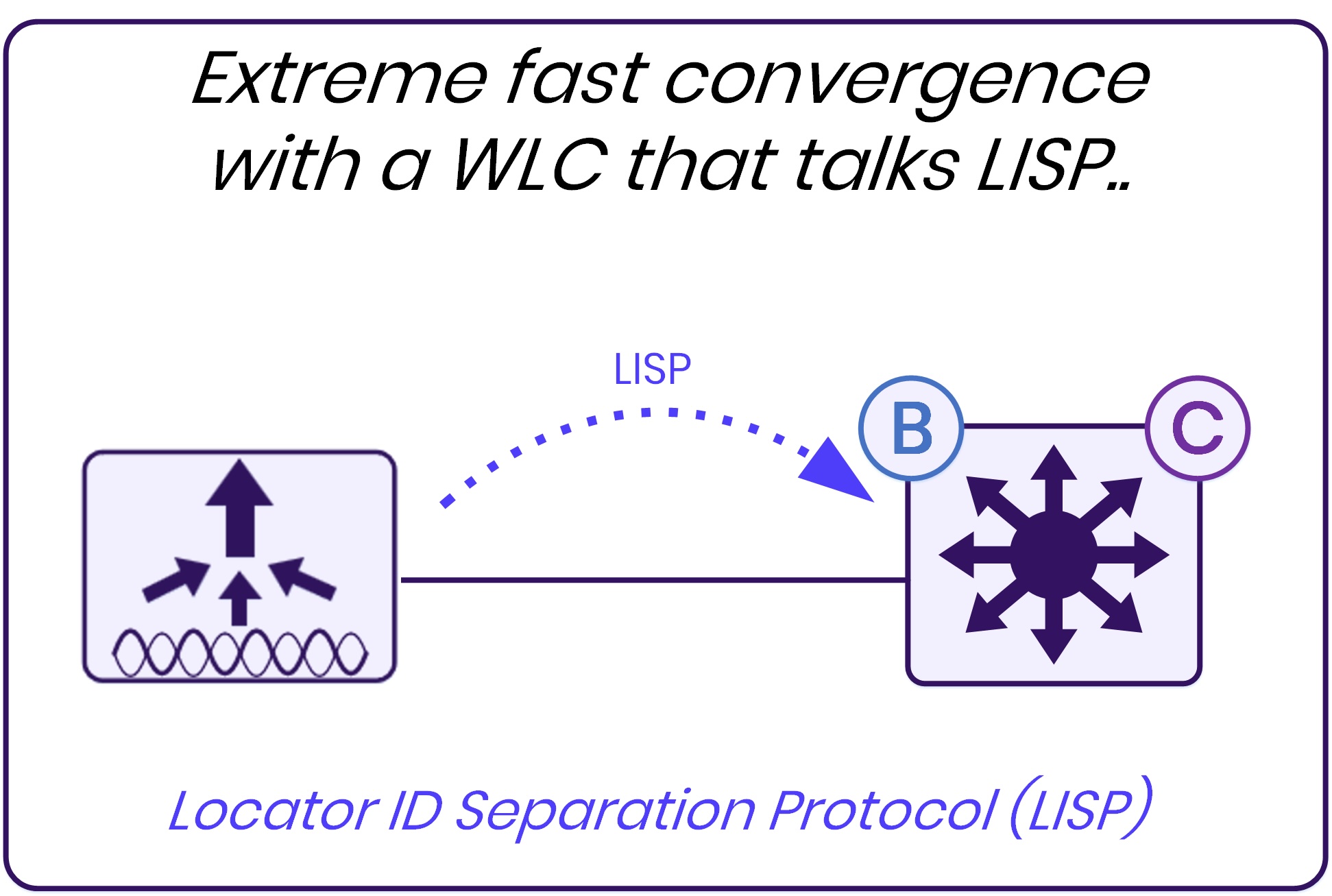
The Wireless LAN Controller plays a critical role in this process by actively participating in LISP signaling within the fabric. The WLC receives reassociation events from access points, understands fabric topologyand Edge Node relationships, and triggers the necessary EID to RLOC updates through the Control Plane node. While the WLC orchestrates mobility, it is never involved in forwarding user traffic. This design prevents the controller from becoming a scaling constraint and allows roaming performance to grow naturally with the size of the fabric.
Much faster than EVPN and Flexconnect
Compared to EVPN based mobility, this approach provides asignificant advantage. In EVPN, a roaming event typically relies on MAC movement detection, followed by control plane signaling and eventual data plane convergence. This process only starts after traffic arrives. With LISP, controlplane and data plane state are updated proactively. By the time traffic reaches the fabric, forwarding paths are already programmed. This is why LISP based roaming consistently converges faster than EVPN in wireless mobility scenarios.
LISP signaling in action
The diagram illustrates endpoint B roaming from an access point connected to Edge 02 to an access point connected to Edge 03.The objective is to preserve the same IP address and identity while redirecting traffic with minimal interruption.
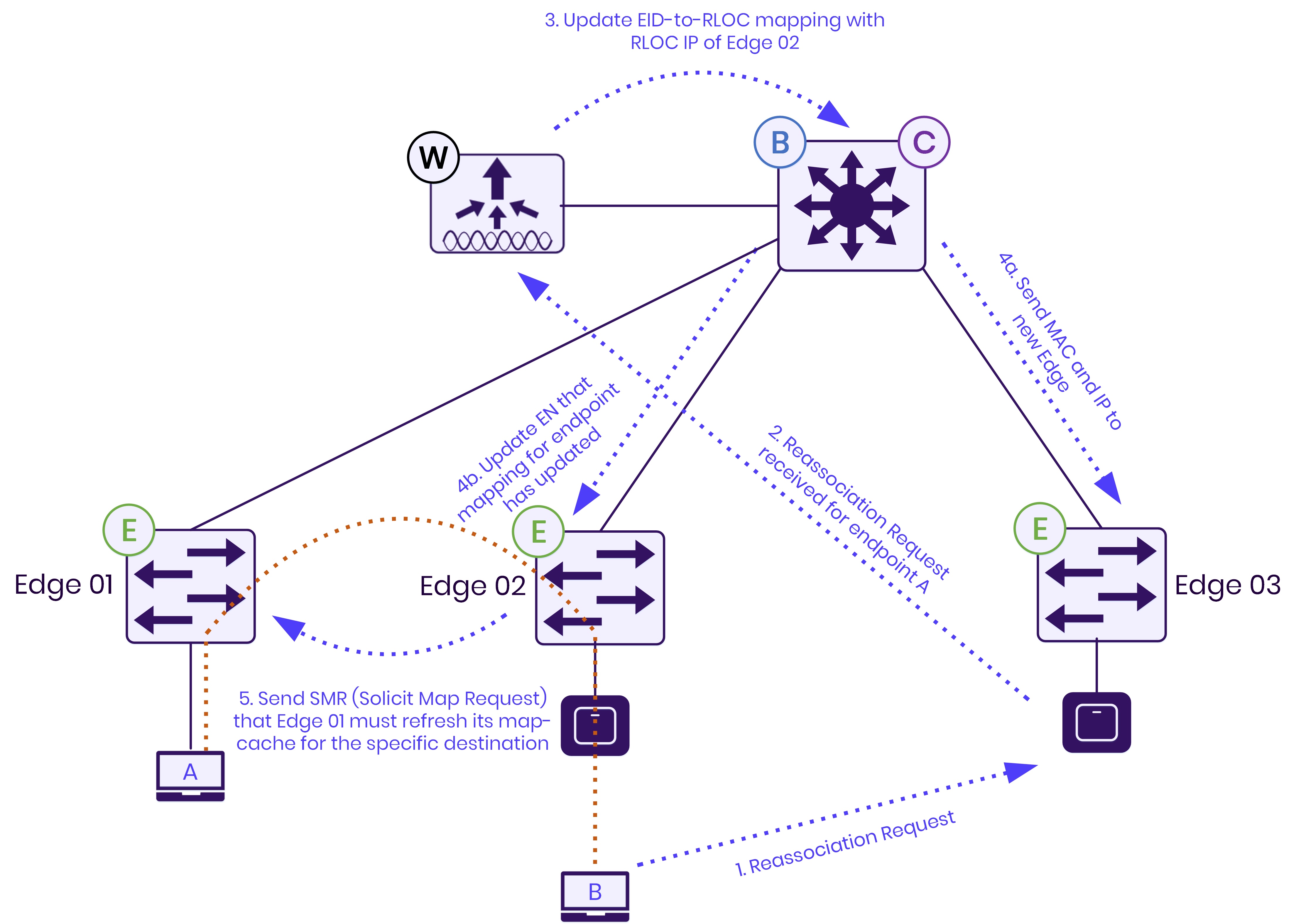
1. The roaming process starts when endpoint B sends are association request to the new access point. At this stage, the endpoint identity remains the same and only the EID-to-RLOC is going to be updated.
2. The reassociation request is forwarded to the fabric enabled WLC. The WLC determines that the new access point is connected to a different Edge Node and initiates the LISP signaling process.
3. The WLC triggers an update in the LISP control plane,updating the EID to RLOC mapping for endpoint B. The new RLOC becomes the fabric facing IP address of Edge 03.
4a. The Control Plane signals Edge 03 with the updated mapping through the LISP control plane, so it is immediately aware that endpoint B is connected to a locally attached AP.
4b. At the same time, the Control Plane informs Edge 02 that the endpoint is no longer locally attached. Edge 02 creates an away entry,ensuring that any traffic destined for endpoint B is forwarded via VXLAN to the new RLOC. This guarantees traffic continuity during the transition.
5. If other Edge Nodes still have cached mappings (like Edge01) pointing to the old location, Edge 02 triggers a SMR (Solicit Map Request).This forces a refresh of the map cache entry so that traffic is immediately redirected to Edge 03. This update is targeted and does not rely on flooding or broadcast mechanisms.
This roaming model scales extremely well because only identity mappings are updated, control plane signaling is lightweight, and dataplane forwarding paths are optimal from the start. The WLC remains out of the data path, eliminating single points of failure and unnecessary hairpinning.
Cisco SD-Access treats wireless mobility as adistributed identity problem rather than a switching problem. By combining LISP for identity to location mapping, VXLAN for optimal forwarding, and acontroller that orchestrates but never forwards traffic, wireless roaming becomes fast, deterministic, and resilient across large campus environments.